
Fluimac air-operated diaphragm pump technology
The Phoenix, Phoenix ATEX, Phoenix Food, Accurate Phoenix, Steel Phoenix, Flap Phoenix and Lotus pumps are air-operated double diaphragm pumps (AODD). They all work on the same principle described below – they are driven by compressed air only, with no electricity. The Piezo pump is also an air-operated diaphragm pump, but with a design developed specifically for wells. The advantages and technical examples on this page (performance curves, suction, viscosity) refer to the Phoenix series – you will find the data for each model on its own page.
Advantages of the Phoenix series

- Wide choice of sizes (from P4 to P1000) and materials – PP, PVDF, POMc, ALU, SS and conductive (+CF) versions – for a wide variety of applications and chemically aggressive fluids
- Dry running without damage to the pump or the system – design without shaft seals
- Dry self-priming up to 5 m (P4 and P8 – up to 3 m) and up to 9.8 m when the pump is filled with fluid (wet suction)
- Safe operation against a closed valve (zero flow) without damaging the pump
- Fully submersible – can work completely submerged, provided the materials are chemically compatible with the fluid
- Passes solids – suitable for abrasive and viscous fluids
- High efficiency and high flow rates thanks to the optimised design of the bodies
- Flow rate and head are easily adjusted through the supply air pressure, with no additional mechanisms
- Lubrication-free pneumatic system, no stalling and no icing
- Efficient air distribution – low air consumption
- Unbalanced pilot valve that controls the main air valve and prevents the pump from stalling
- Self-lubricating acetal spool – long air valve life
- Air chambers in solid polypropylene and plastic air valve – resistant to chemicals and corrosion
- The air distributor is accessible from outside for quick inspection
- Fully bolted assembly – reliable sealing and protection against leaks
- Special diaphragm clamping that reduces wear and prevents leaks
- Diaphragms with long service life and constant performance
- Exhaust chamber with double silencer – low noise level and less icing
- Quick and easy service without special tools
- Various port connection options and material combinations to suit the application
- ATEX certification for all versions, conductive versions for zone 1
- Every pump is 100% tested after assembly – operation against a closed outlet, suction and sealing
- Compact design – foot mounting, suspended, ceiling mounting or on a trolley for easy moving
How a diaphragm pump works

1. Suction cycle
Compressed air fills the right air chamber and pushes the right diaphragm. The left diaphragm, connected to it by a shaft, creates suction – the lower ball lifts and the fluid enters the pump through the inlet. At the same time the right chamber is in the delivery cycle.

2. Delivery cycle
Compressed air fills the left air chamber and the left diaphragm pushes out the fluid – the upper ball lifts and opens its way to the outlet. At the same time the right chamber is in the suction cycle. The two cycles alternate automatically thanks to the air distributor, without any electrical control.
Installation options


Phoenix pumps can also be installed suspended or on feet – including a ceiling-mounted version.
Choosing a pump
To choose the right Fluimac pump for your application and ensure long life, economical operation and minimal maintenance, consider:
- the properties of the fluid – chemical composition, viscosity and presence of solids,
- the required flow rate and head,
- the suction and delivery conditions.
The optimal pump size is the one where the duty point (flow rate and head) falls around the middle of the performance curves.
The pumps are available with different inlet and outlet connection options and with different material combinations to suit the application.

Performance curves
To select the pump size and the supply air parameters, you need to know:
- the required flow rate,
- the total head the pump must overcome.
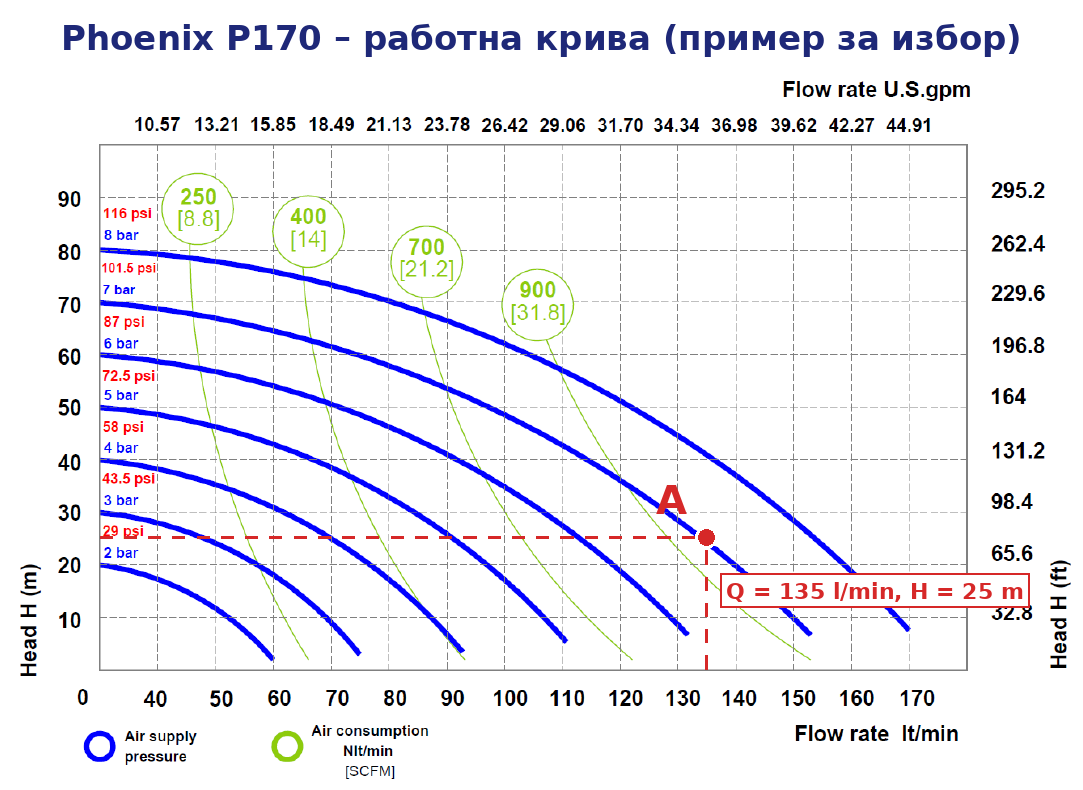
Example: a Phoenix P170 pump must deliver 135 l/min at a head of 25 m. Point A on the chart is where these two values meet.
The blue curves show the supply air pressure. The closest to point A is the 7 bar curve – this is the air pressure needed for this duty point.
The green lines show the air consumption. The closest to point A is the 900 Nl/min (normal litres per minute) line – this is how much air the pump will consume.
The curves were measured with water at 20 °C, with a flooded suction line and free outlet, under other conditions the values may differ. You will find the performance curves of each model on the pump page.

Suction and flow rate
The chart shows how the flow rate drops when the pump works with suction lift (installed above the fluid level). For example, at a suction lift of 4 m the flow rate drops by about 20%. Valid for pumps with a connection size of ¾″ and larger, the values depend on the pump configuration.

Viscosity and flow rate
As viscosity increases, the pump flow rate decreases. For example, with a fluid of 6000 cPs (centipoise) the flow rate is about 60% of the flow rate with water (100% = water). Valid for pumps with a connection size of ¾″ and larger.