
Fluimac peristaltic pump technology
The peristaltic pumps Helios are positive displacement pumps: the liquid moves only inside a flexible hose, which the rollers of the rotor squeeze and release. The liquid does not come into contact with any mechanical parts – there are no valves or mechanical seals. This makes the pumps suitable for abrasive, viscous, aggressive and sensitive liquids and for accurate dosing. The series Helios AS is for low pressure and dosing, Helios ATR – for high flow, and Helios ASP – for high pressure.
How a peristaltic pump works
- Hose. The liquid stays inside a flexible hose fitted in the pump casing.
- Squeezing. The rollers of the rotating rotor squeeze the hose and close it completely.
- Displacement. A fixed volume of liquid is trapped between two rollers and pushed by the roller towards the outlet.
- Suction. Behind the roller the hose returns to its round shape thanks to its elasticity and draws in new liquid.
- Accurate dosing. Each revolution of the rotor displaces the same volume – the flow rate is proportional to the speed and easy to adjust.
Advantages
- No mechanical seals or valves – no leaks and almost no parts to maintain.
- Abrasive, viscous and with solids – gentle squeezing that does not break particles or sensitive products.
- Self-priming – suction lift up to 8 m with an empty hose (depending on the series), without a foot valve.
- Dry running without damaging the pump.
- Reversible – reversing the direction returns the product from the delivery line and reduces losses.
- Hygiene – suitable for CIP and SIP cleaning; versions with FDA hoses for food.
- No oil bath – in the roller versions the rollers roll along the hose, so no oil or glycerine is needed that could contaminate the product if the hose breaks.
- Safety – a hose rupture sensor stops the pump or triggers an alarm.
The hose – the heart of the pump
The hose is the only wear part. Its material is chosen according to chemical compatibility with the liquid – for example natural rubber (NR), NBR, EPDM, Hypalon, silicone, Norprene, Pharmed or Tygon (depending on the series). The reinforcing layers absorb the pressure and abrasion.
Hose life depends on the temperature, pressure, aggressiveness and abrasiveness of the liquid and on the speed – lower speeds extend its life. Replacement is quick and simple, so a separate hose can be used for each product.
Drive and connections
- Standard electric motor, forced-ventilation motor or ATEX motor.
- Flow regulation with an inverter or a mechanical variator; pneumatic drive on request.
- Connections: hose tail, threaded, flanged, Tri-Clamp and DIN; special connections in PP and PTFE.
- The casing can be protected with an inert ceramic coating in case of hose rupture.
Helios series
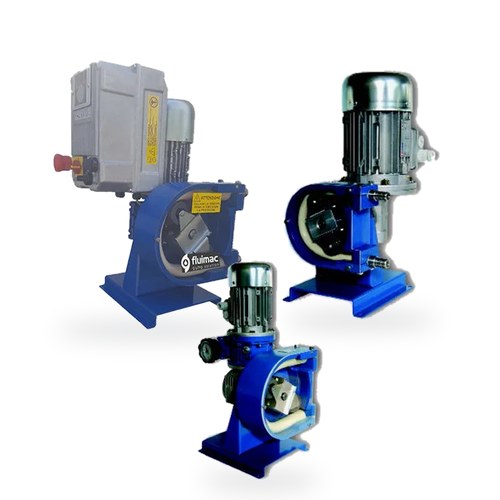
Helios AS – low pressure
For precise dosing of corrosive, viscous and abrasive liquids – pressure up to 4 bar, suction lift up to 6 m.
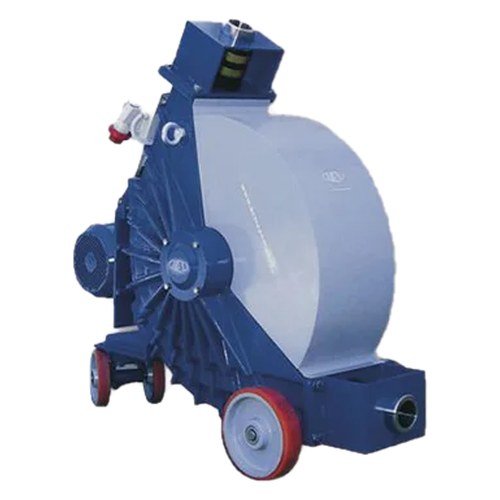
Helios ATR – high flow
For industrial pumping of viscous and aggressive liquids – pressure up to 8 bar, suction lift up to 8 m.
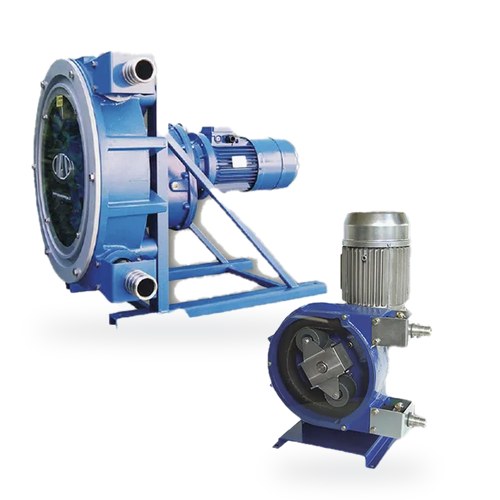
Helios ASP – high pressure
For large quantities of viscous and aggressive liquids at high pressure – up to 10 bar, suction lift up to 8 m.
Choosing a peristaltic pump
When choosing, we take into account:
- the type of liquid – chemical composition, viscosity and solids content;
- the required flow rate and back pressure;
- the temperature and the operating mode – continuous or intermittent;
- the hygiene and safety requirements (food, ATEX);
- the hose material and its expected life.
Contact us – we will select the series, hose and drive for your application.